
What is Tabby worth
A brief research report on Tabby and its peers in the West

Good morning,
The first half of 2017 (or perhaps the entire year) was arguably one of the most significant periods for ecommerce in the Middle East, shaping the sector in various ways.
Indirectly, it also led to the founding of what has become the region’s highest-valued venture-backed internet company, making it relevant to today’s Termsheet.


Towards the end of the first quarter, on March 28, 2017, Amazon announced it had acquired Souq.com, the leading ecommerce marketplace in the Middle East, for an undisclosed sum, which was later confirmed to be $580 million.
The deal was finalized after months of speculation, with multiple companies, including eBay, India’s Flipkart, and UAE retail group Majid Al Futtaim, showing interest in acquiring Souq. However, the talks with each of them eventually fell through.
Just a day before Amazon and Souq announced the acquisition, Mohammed Alabbar’s Emaar Malls confirmed it had submitted an $800 million bid for Souq.
This was less than five months after Alabbar announced Noon in partnership with the Public Investment Fund to challenge Souq.
After the failed attempt to acquire Souq, on May 11, 2017, the Alabbar-led fund announced the acquisition of UAE-based ecommerce marketplace JadoPado, with co-founder Omar Kassim joining Noon as CTO. He stayed at the company for less than three weeks.

Important Note
This is a long post, and your email provider may cut it off. Read the full version on the web.

On May 24, 2017, Emaar Malls acquired a 51 percent stake in the fashion ecommerce platform Namshi for $151 million.
This was the second-largest tech acquisition (third with Media.net as part of dataset) in the Middle East, after Souq, according to Termsheet Research. The two largest acquisitions in the region (at the time), Souq and Namshi, happened just two months apart.
Following the Namshi acquisition, two of its co-founders, Faraz Khalid and Hisham Zarka, left to join Noon as CEO and CTO.
In September 2017, after months of delays, Noon finally went live in the UAE and later expanded to Saudi Arabia and Egypt.
Hosam Arab continued to lead Namshi after Faraz Khalid and Hisham Zarka’s departure.
About two years after acquiring the majority stake, Emaar Malls acquired the remaining 49 percent of Namshi for $129.5 million, making it Rocket Internet’s biggest exit in the Middle East.
Just two weeks after the complete acquisition, in March 2019, Hosam Arab, Namshi co-founder who built and led the company to this successful exit, announced his departure.
For a piece I was writing on MENAbytes at the time, I asked Hosam about his plans, “It’s still early days. I will be taking some time off over the next few months to spend with my family. During that time, I will be exploring ideas most likely in the digital space and most likely right here in the region,” he explained.
Six months later, in November 2019, Hosam reached out to announce his new business and its seed round. What happened between May and November is beautifully captured by Noor Sweid in her just-released book Coming of Age.
Hosam was restless. He had already founded and exited an ecommerce company, Namshi, the Middle East’s online destination for fashion and lifestyle, to Noon, in a successful transaction. Being someone who lives, sleeps and breathes ideas, he now felt stuck. Everywhere he looked, there were ideas and opportunities that were disturbing his desire to take some time off after building his last company.
But his mind was off to the races. He knew he wanted to do something in the fintech space since those had been the largest challenges he had encountered as a founder. Yet, even after narrowing it down to fintech, there was so much to do. The opportunities were endless. And there was so much competition, there were an infinite number of fintech in the MENA region now, each one tacking one of the multitude of problem the industry presented.“My initial idea had been to take some time off. However, it was all down to timing as it was before the summer holidays and the kids were still in school so I couldn’t just set off and travel on my own. I did some thinking and one of the ideas was Buy Now Pay Later (BNPL). I had discussed it with a few people then I got this random call from a friend who said there was an investor in town who had already put money into BNPL solutions in other markets and they’d like to meet you.”
It took one more meeting in New York and the deal was done.
This BNPL investor was Melissa Guzy from Arbor Ventures. I had a hunch about it and had the Tabby founder confirm it.
Hosam was likely going to build a BNPL platform regardless, but the conversation and deal with Arbor may have pushed him to move faster.

Just over five years ago, Tabby announced its pre-product seed round. Last month, it raised funds at a $3.3 billion valuation, making it the most valuable venture-backed internet company in the Middle East.
Apart from Careem, no other venture-backed private company in the region has crossed the $1.5 billion valuation mark.
Among publicly listed internet companies in the Middle East, only Talabat; a Delivery Hero spin-off has a higher valuation than Tabby.
If we exclude Talabat, Tabby stands as the highest-valued tech company ever built in the Middle East.
In this piece, I'll try to evaluate what it's worth by comparing its offerings and numbers with international peers.
I'll also discuss the company's products, revenue sources, growth, and progress since it was founded five years ago. Think of it as a brief research report on Tabby, especially if you read it alongside the previously published BNPL piece and industry charts available on Termsheet.

Let’s start with this quick chart.
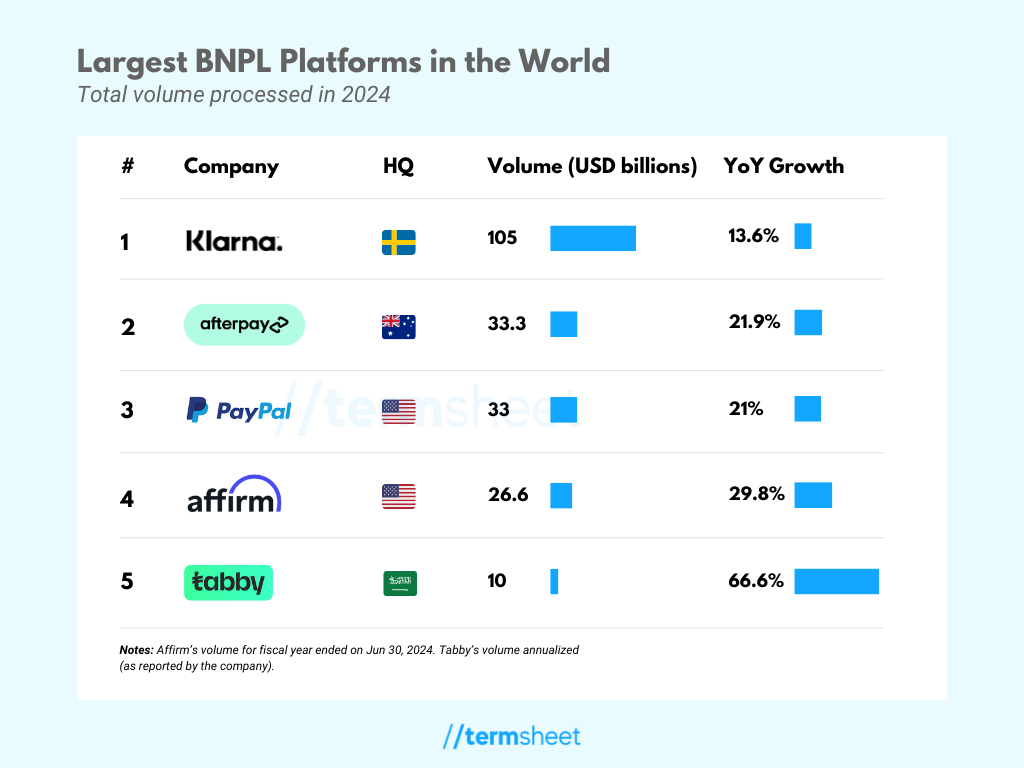
It hasn’t been widely discussed, but Tabby has grown to become the fifth-largest BNPL platform in the world, according to Termsheet Research.
There’s an important caveat, though: Tabby’s GMV is annualized. While it’s unclear what period it's annualized from, the company shared this figure in January, suggesting it’s based on December’s GMV.
Applying a 25 percent haircut to Tabby’s reported annualized GMV of $10 billion suggests its underlying GMV for 2024 could be around $7.5 billion. This figure still exceeds Zip’s estimated GMV of $6.4 billion for the same period.


Even adjusting for a 25 percent haircut, Tabby's 2024 GMV would approximate $7.5 billion, still higher than the sixth-ranked BNPL player, Zip, which did about $6.4 billion in 2024.
But more importantly, Tabby is growing much faster than any other BNPL player in the world, with approximately 67 percent growth in volume in 2024. That’s more than double the growth rate of the second-best performer, Affirm, which grew by around 30 percent.
It’s essential to note, though, that Tabby is growing from a much lower base compared to larger players like Klarna and Afterpay.
Here’s another interesting chart to put the growth in context.